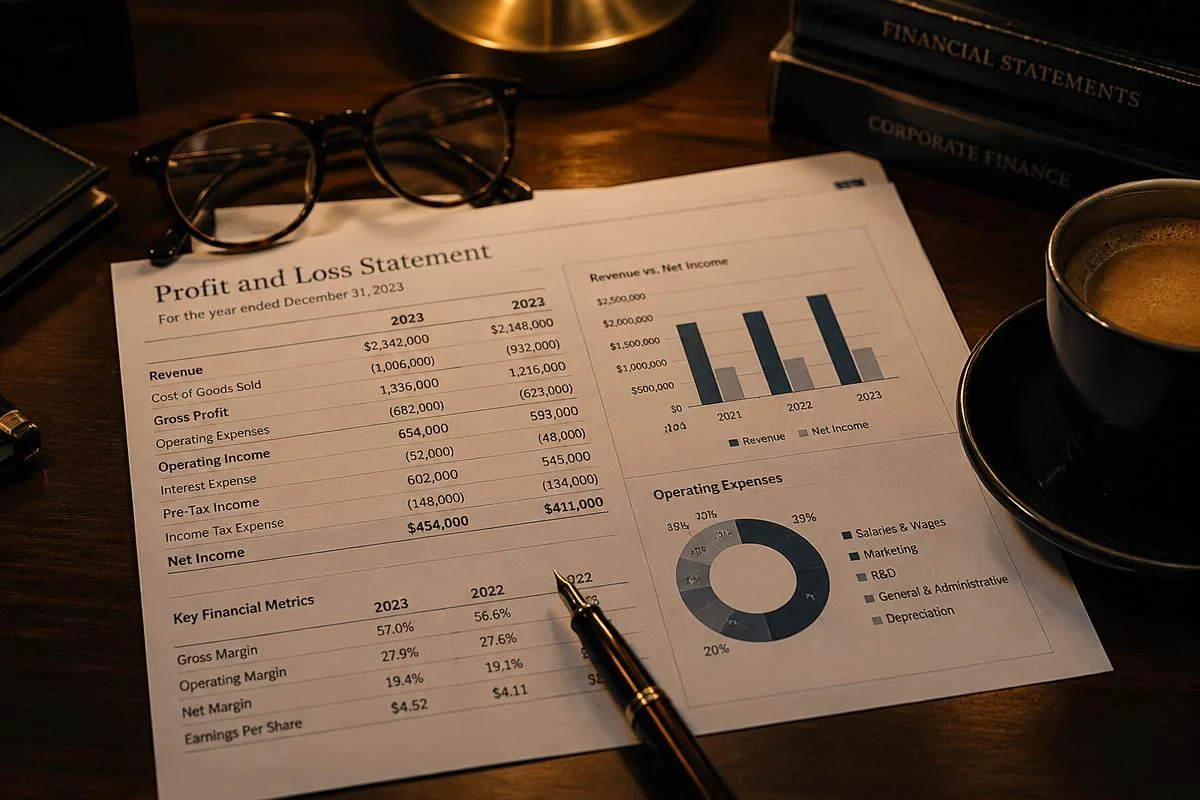
How to actually read your Profit & Loss statement
Most business owners glance at the bottom line of their P&L and move on. But the statement is designed to be read top to bottom — it tells a story about pricing, spending, and efficiency in a specific order. Learning to read that story turns your P&L from a tax-time formality into a weekly steering tool.
Start with revenue — but ask what is inside it
Revenue is not one number; it is a mix. If you sell products and services, or one-time and recurring work, those lines should be separated. A rising total with a shifting mix can hide a shrinking core business.
Gross profit is the health check
Gross profit — revenue minus direct costs — answers whether the work itself makes money. Watch gross margin as a percentage, not just a dollar figure. If margin slides two or three points, something changed: pricing, supplier costs, or scope creep on fixed-fee jobs.
Read operating expenses in groups
Rather than auditing every line, group expenses into three buckets and check their trend:
- People — payroll, contractors, benefits. Usually the largest and worth the closest look.
- Tools and overhead — software, rent, insurance, subscriptions.
- Marketing and sales — spend that should justify itself in revenue.
When one bucket grows faster than revenue for two or three months in a row, that is where the conversation starts.
The bottom line, honestly read
Net income tells you what happened. Margin trends tell you what is about to happen.
A profitable business with a declining margin has a problem arriving on a schedule. Comparing each month against the same month last year — not just the previous month — removes seasonality and shows the real direction of travel.
If reading your own P&L still feels like decoding a foreign language, that is a bookkeeping problem, not a you problem. Well-kept books produce statements that explain themselves — and we build exactly that.
Written by Eric R Curtin, Founder and Principal of Black Tie Bookkeeping in Saint Augustine, Florida. Questions about your books? Get in touch.